Assumptions
- linear consumption function
- closed economy
IS-LM Model
the IS-LM Model is used to model how the GDP changes from one year to another. A short-term model compared to the long-term methods mentioned previously.
… Investments (private and companies) … Government Expenditure … Consumption (private individuals) … Exports … Imports … Net Exports
Assuming a closed consumption:
Consumption
a function defined on disposable income: … Taxes … “substistence” consumption (base consumption) … (marginal) propensity to consume when income increases
with a linear model we end up with:
… investment rate (because one can either spend or save income)
Investments
- interest rate: Exogenous Number
- interest rate … cost of borrowing money
- if borrowing money is more expensive I can borrow less, therefore invest less
- assumption: linear investment function
Government Expenditure
- Exogenous Number
- would be dependent on taxes … not in this model tho
- e.g. roads, universities, wages
Putting it all together
Equilibrium
aggregate demand = aggregate supply This will be a classic line
Where both lines meet the equilibrium is located
- line 1:
- line 2:
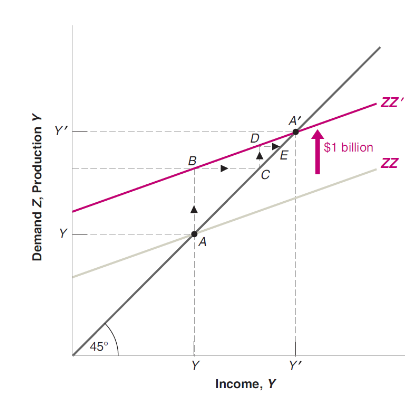
Equilibrium
- private saving:
- income - taxes - consumption
- government saving:
- taxes - government spending
Transformations
more government expenditure → … multiplicator, Fiscal Multiplier
more taxes → … fiscal factor for taxes
Paradox of Thrift
- when saving more (decrease ) the GDP decreases in the short run
- but the savings will finance the long-run development
- Ricardian equivalence theory
Fiscal Multiplier
There are economies where the fiscal multiplier is smaller than 1.