No more givens
- until now prices were given
- now not anymore
Overview
| Buyers / Sellers | One | Few | Many |
|---|
| One | Bilateral monopoly | Limited Monopoly | Monopoly |
| Few | Limited Monopsony | Bilateral oligopoly | Oligopoly |
| Many | Monopsony | Oligopsony | Polypoly |
Competition vs Monopoly
- competition ⇒ Monopoly
- many sellers buyers ⇒ one seller, many buyers
- homogeneous good ⇒ single product
- free entry for competitors ⇒ limited entry (Market Entry Barriers)
- price is given ⇒ price is set by company (high market power)
- p = MC, p = AC ⇒ profit is maximized by output of q where MR=MC
Market Power
- if players in an Oligopoly are talking to one another they can form an almost monopoly where they can plan their joint supply
- results in market power similar if not equal to monopoly
- market power … ability to influence the market
- in perfect competition the price is given → 0 market power
Math and Stuff
Marginal Revenue Function (Linear)
- demand/price: P(Q)=a−bQ
- Revenue: R(Q)=P(Q)∗Q=(a−bQ)∗Q=aQ−bQ2
- MR(Q)=a−2bQ
- same curve, but with twice the slope
Increasing Production
- increasing production will increase the revenue
- but the price needs to be adjusted → demand stays equal
- MR<p … Marginal Revenue always optimal, production below optimum
Price Setting
- in a monopoly there is 1:1 mapping between price and demand
- we can choose the price and find out about the demand then
- very easy to calculate the revenue
- optimal production rate when factoring in costs
- Marginal Costs = Marginal Revenue is best production cost
- MC=MR
- from that we get the optimal quantity to produce
- from what we can get the price with the demand function
MR=p+pεd1
- εd … elasticty → Micro Formula Sheet
- in perfect competition: εd=−∞⟹MR=p
- constant marginal revenue: horizontal curves
- small price increase → complete loss of demand
- market power: −1>εd>−∞⟹MR<p
- negatively sloped market demand & marginal revenue curves
- inelastic demand −1<εd<−∞⟹MR<0
- negative marginal revenue → choose an output level which is in elastic demand
Optimal Prices
p=mMC
Lerner Index
pp−MC=−εd1
- Lerner index … left side
- 0<L<1
- the higher the Lerner index, the less competition
- the higher the markup, the less competition
| Industry | Lerner Index | Markup Factor |
|---|
| --- | | |
| Food | 0.26 | 1.35 |
| Tobacco | 0.76 | 4.17 |
| Textiles | 0.21 | 1.27 |
| Apparel | 024 | 1.32 |
| Paper | 0.58 | 2.38 |
| Chemicals | 0.67 | 3.03 |
| Petroleum | 0.59 | 2.44 |
Measuring Monopoly Power
- Lerner Index 1 → complete Monopoly
- Lerner Index 0 → perfect competition
- everything in between is some gradual change between extremes
Monopoly and Demand
- more elastic demand → lower markup
- less elastic demand → higher markup
HHI Index
Social Cost
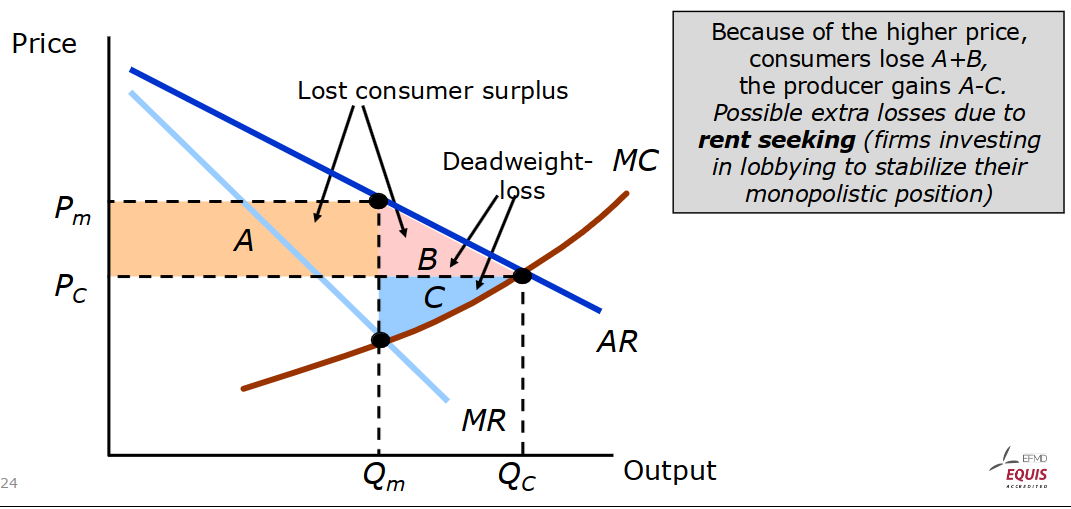
- consumer surplus … difference between willingness to pay and actual price
- producer surplus … profit + fixed costs
- monopoly produces less units at higher price
Natural Monopoly
- similar to Economy of Scale
- when a single company can produce all the supply cheaper than if the load was split among multiple companies
- very high fixed costs, low variable costs
- subadditive cost function … f(x,y)<f(x)+f(y)
- examples:
- Railroads
- Roads
- Telecommunications
- Electricity
Regulating the Price
- setting ceiling to the competitive level → not good
- at this level the company would not work
- setting ceiling such that the company has no profit → perfect
- company is willing to produce, but has little to no profit
- best for maximized consumer surplus
- infeasible due to lobbying and political ambitions
Different Production Costs
- marginal costs should be equal in all sites MC1=MC2
- first-order condition still holds:
- only partial redistribution of production, not complete redistribution
Monopsony
- exact opposite of monopoly
- all market power with demand side
- e.g. military, labor market (in certain industry)
- military is just 1 per country, but with many defense contractors
- labor market can force low wages with lower amount of people
- instead of profit there is net value
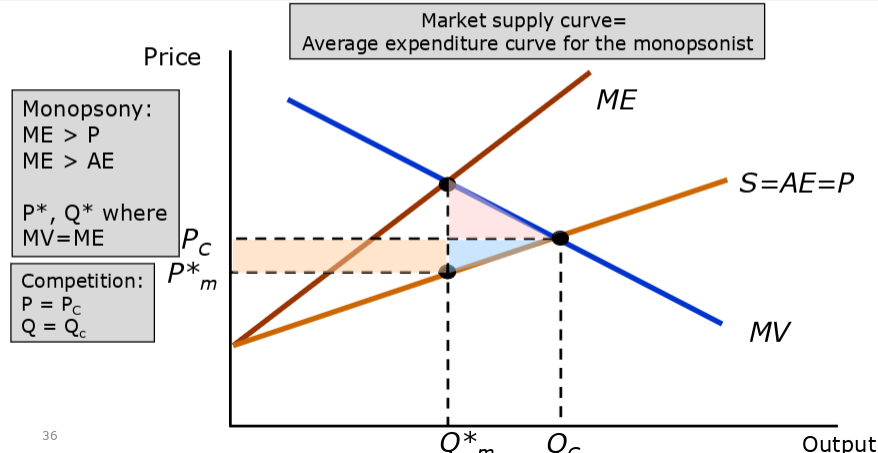
- Marginal Value = Marginal Expenditure
- monopsonist buyer wants to maximize net value
- sources of power
- inelastic market supply
- small number of buyers (or just 1)
- little competition between buyers
- Monopoly: Marginal Expenditure = Actual Expenditure = Supply = Value
- Monopsony: Supply = Average Expenditure = Price
- basically suppliers are forced to produce below market value
Monopoly vs Monopoly