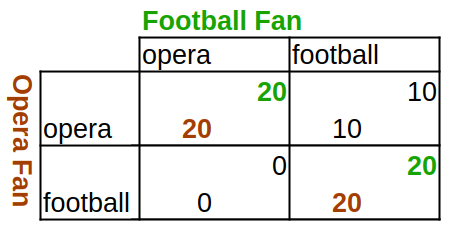
best as long as both choose the same, no incentive to deviate
Comparison with previous Games
chance is here not necessary to produce a positive output
both have a subgame strategy of going to the own venue (top right)
collusion can only happen when 1 - and only 1 - player is deviating from their subgame strategy to increase the payoffs
Analysis Problems and Long-Term Thinking
analysis
nothing interesting, perfect 50/50 split as if picked randomly
long-term marriage
one can think of colluding to always go to either venue together (both opera or both football) which will leave one of the players with a higher payoff
in reality there will be some arrangement of alternating the venue either each time or occasionally to create equal payoffs for both partners
Experiment 18
Nash Equilibria Normal Form
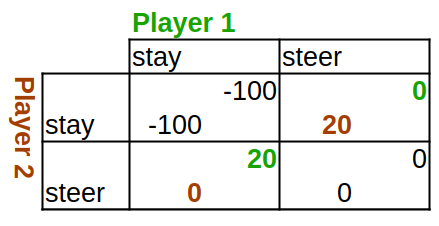
2 opposite NE with incentive to deviate
1 stay, 2 steer
1 steer, 2 stay
I can only gain what you loose (opportunity cost)
Difference to Prisoners Dilemma
PD has just 1 clear NE in normal form and 1 better NE if collusion is possible
as long as I don’t deviate, there is no chance of being hurt by other player
this game has 2 NE where the activity of either player is always hurting the other player through opportunity cost
risk of a crash which hurts both players considerably
Commitment and Comparison to 5
commitment … would be something like being crazy in experiment 5
strategic move of removing the steering wheel
player is now unable to steer away such that the other player is forced to steer to avoid certain destruction
similar to the doomsday machine which we also watched a video on
Analyze data
crash ratio:
crash ratio of crashes in random distribution: 25% (1/4)
crash ratio in experiment: 21.5% → indicates more risk averse than if picked randomly
profit ratio:
profit ratio in random distribution: 50% (1/4 + 1/4)
profit ratio in experiment: 52.7% → indicates players which took advantage of risk aversion of other players
overall stay decisions per round (out of 62)
1: 30, 2: 31, 3: 28 (symmetric each round)
about half of individual decisions was to stay
profit per round
1: -800, 2: -1800, 3: -1400 (must by symmetric too)
hypothesis
by pure chance in round 2 the non-steering players were matched
stay/steer decisions mostly unchanged through all rounds