Identical Products
- compete through price rather than quantities
- oligopolistic industry
- equilibrium price depends on homogeneity of products
- applicable when changes in capacities are easy to make
Bertrand Paradox
- homogenous products
- one firm undercuts the others
- other firms have to adjust (or undercut others themselves)
- strong incentive to undercut everyone
- strong incentive to keep decreasing until p = MC
- just 2 firms are enough to reach equilibrium
- shows importance of strategic variables (price vs quantity)
- is a form of Nash Equilibrium
- criticism:
- seems unnatural for firms (gentlemen’s agreement)
- even at equal prices the firms do not share the market 50/50 necessarily
Different Products
- small differences (still same market)
- each firm sets it’s own price and takes price of competition as given
- oligopolistic industry
- profit maximization:
P1∗=2b1a+b2+P2+c1b1
- afterwards same thing for $P_{2}^{*}$
- then solve for both unknowns $P_{1}$ and $P_2$
- result:
- when firm 2 increases prices, firm 1 should increase prices as well
Graphically
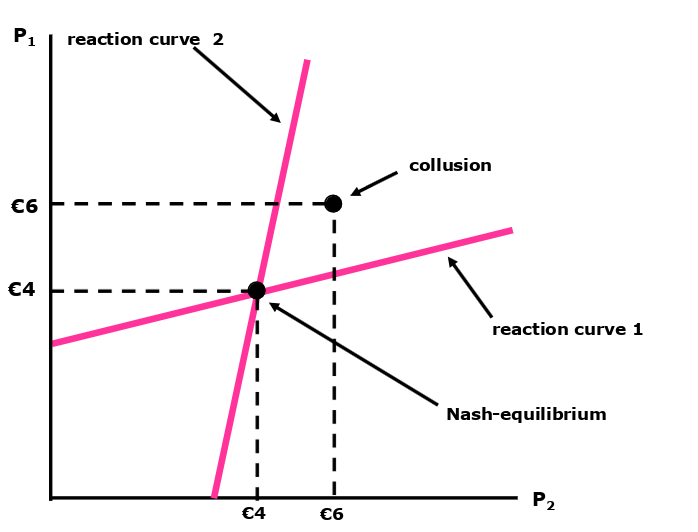
- Collusion … Cartel price setting
- related to Dilemma Games
- it would be best (highest profit) for both companies to collude
- but competing is always the dominant strategy