Definitions
- Emotion - indicates a subjective, affective state ( reaction pattern) that is relatively intense and that occurs in response to something we experience
- Mood - prolonged, less intense, affective state that does not occur in response to something we experience
Process of Emotions
Old Theories
- James-Lange theory
- arousal → heart pounding → fear (emotion)
- Canon-Bard theory
- arousal → { heart pounding + fear (emotion) }
- Schachter-Singer two factor theory
- arousal → { heart pounding + cognitive label (I’m scared) } → fear (emotion)
Current Theory
- subjective experience
- While basic emotions are expressed by all individuals regardless of culture or upbringing, the experience that produces them can be highly subjective
- physiological response
- This physiological response is the result of the autonomic nervous system’s reaction to the emotion we’re experiencing. The autonomic nervous system controls our involuntary bodily responses and regulates our fight-or-flight response
- behavioral response
- The behavioral response aspect of the emotional response is the actual expression of the emotion. Behavioral responses can include a smile, a grimace, a laugh or a sigh, along with many other reactions depending on societal norms and personality
Misattribution of Arousal
- arousal can be generally within situation, not with specific sources
- it doesn’t matter where the arousal comes from, all arousal is equal
- Dutton & Aaron (1974)
- n = 85
- setup
- arousing chain bridge (swaying, tilting, etc… feeling of falling off)
- vs. non-arousing solid bridge
- doing a questionnaire on the bridge with some sexual content
- result
- men on the arousing bridge produced more sexual imagery in their stories, called the interviewer more often afterwards (50% vs 12.5% control group)
- arousal of bridge (fear) transposed to sexual arousal
Primary vs Secondary
- primary emotion
- directly triggered by event
- love, joy, anger, sadness, surprise, fear
- secondary emotion
- depending on situation and primary emotion
- passion, optimism, irritation, disgust, shame, nervousness
Perspectives
- pessimistic view
- bring about impulsive decisions
- adversely affect decision-making process by influencing informed beliefs
- emotions can be in the way of rationality
- optimistic view
- emotions play a positive role in the decision-making process
- emotions show information about aspects that cannot be inferred consciously
Affect Integrated Model of Decision Making
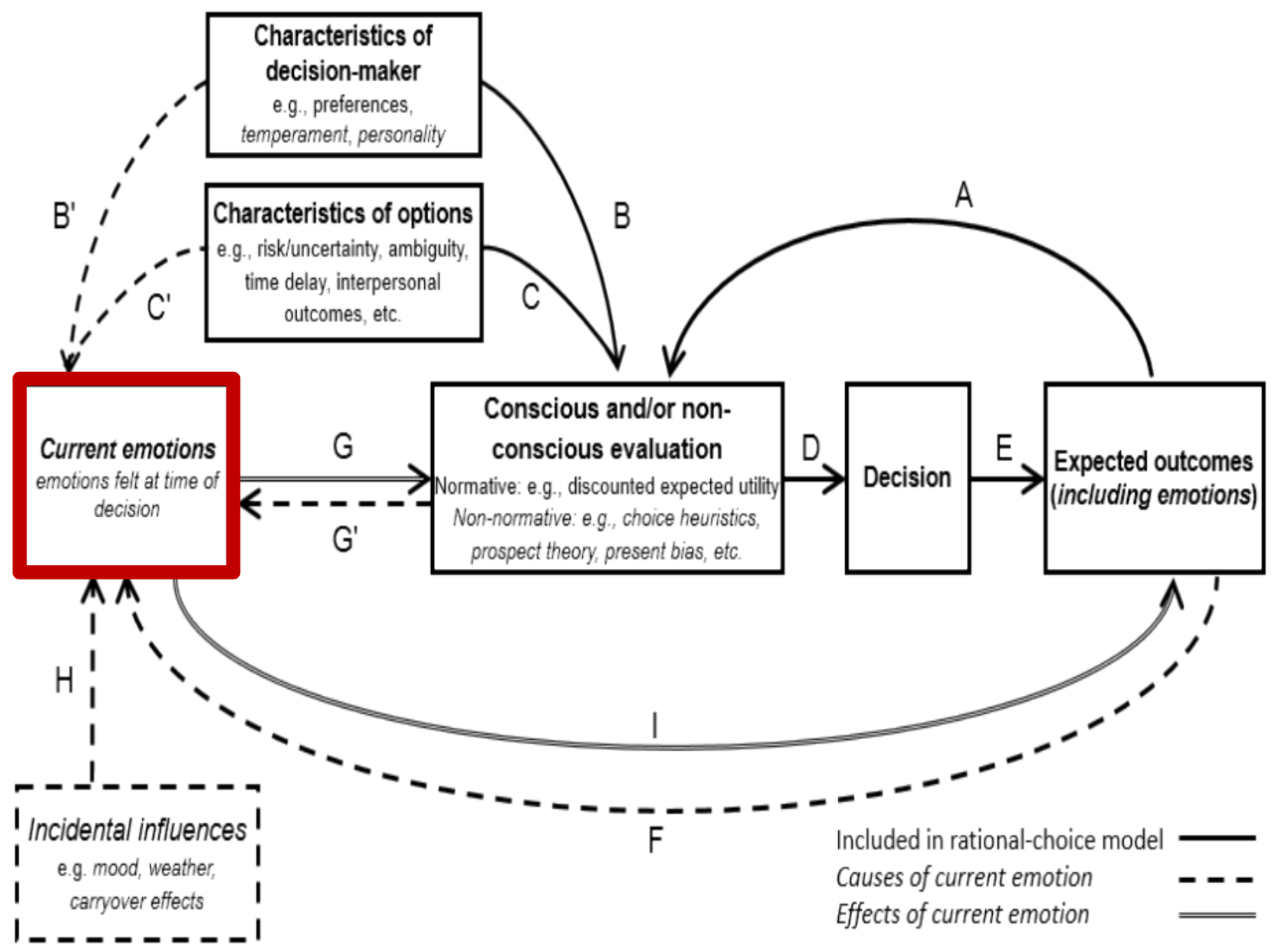
- current emotions influence the situation and the expected outcomes
- what I expect influences my current emotions and my evaluation
- if I’m sad I won’t have a good expectation and therefore a bad evaluation
- characteristics of decision-maker and options
- incidental influences (bodily condition, mood, weather, carryover effects)
Effects of Fear and Anger
- fear … generally applicable security measures
- anger … more optimism, specific security measures
Expected vs Immediate Affect
| ref | expected affect | immediate affect |
|---|---|---|
| definition | Prediction about how I will feel when a certain event occurs | Affect felt during the decision (due to the expectation or due to other influencing factors) |
| time | future | today |
| advantages | Best way to ensure long-term well-being | Prioritizes information processing and fosters important considerations |
| disadvantages | Expectations might be wrong | Might lead to a decision which goes against our own interests |
Financial Cost of Sadness
- Lerner & Weber (2013)
- n = 202
- setup
- first watch a clip (neutral, disgusting, sad)
- then decide between receive money now and receive more money in 1-6 weeks
- result
- sadness reduces patience
- 13% to 43% less money to skip period of 3 months until payment
Emotions and interaction between people
Emotions at Work
- influence belief about value of job, company or team
- affects behavior at work
- events cause different emotions in different people
- symmetrical emotions → self-reinforcing in both positive/negative aspects
- positive emotions produce more positive emotion-inducing behavior
- negative emotions produce more negative emotion-inducing behavior
- pride:
- self-focused positive emotion
- appraisal of self-success, status and competence
- interest:
- being engaged, caught up, fascinated, curious
- creates sustained motivation
- guilt:
- moral emotion, violating social norms
- triggers reparatory behavior - apologizing, changing own behavior
- boredom:
- “the aversive experience of having an unfulfilled desire to be engaged in a satisfying activity”
Emotions & Decision-Making
pasted from slides
- Integral emotions influence decision making
- Integral emotion as beneficial guide
- Integral emotion as bias.
- Moderating factors.
- Incidental emotions influence decision making
- Incidental emotion as bias. Spillovers (Han et al, 2007, Keltner & Lerner 2010)
- Negative (vs. positive) newspaper stories → pessimistic estimates of fatalities (e.g. frequency of hart disease, Johnson & Tversky, 1983)
- Beyond valence: Specific emotions influence decision making
- Emotions of the same valence, such as anger and sadness, are associated with different antecedent appraisals (Smith & Ellsworth 1985)
- Predictive power of models including specific emotions exceeds valance based models.
- Emotions shape decisions via the content of thought
- E.g., angry people will view negative events through a lens that regards them as predictably caused by, and under the control of, other individuals. In contrast, fear involves low certainty and a low sense of control, which are likely to produce a perception of negative events as unpredictable and the result of situations rather than individual failings
- Emotions shape the depth of thought
- Emotions signal that a situation demands additional attention (Schwarz, 1990, Schwarz & Bless, 1991)
- In a positive mood, greater use of heuristic cues (Bless et al.1996, Bodenhausen et al 1994)
- Emotions shape decisions via goal activation
- Discrete emotions trigger discrete implicit goals
- According to the “Feeling is for doing” model, the adaptive function of emotion is defined by the behaviors that specific states motivate.
- Emotions influence interpersonal decision making
- Emotions = inherently social & complex in their nature
- E.g., people derive happiness merely from opportunities to help and give to others with no expectation of concrete gains (Dunn et al 2008, Dunn et al 2011
Sensemaking
the process by which individuals create meaning in the uncertain or ambiguous situations often found in organizations
- emotions affect 3 stages of sense making process
- help initiate sense making
- may influence results by the kind of cognitive processing they trigger
- may help inform sense makers of when their new model makes enough sense
Emotional labor
- regulating feelings and expressions to meet organizational standards
- surface acting: just displaying different emotions - same internal feelings
- deep acting: effortfully changing internally felt emotions
- more natural and genuine emotional displays
Emotional Intelligence
- recognize and understand own emotions and those of others
- 4 pillars
- self-awareness - accurately perceive, evaluate, display emotions
- self-management - control and direct emotions when necessary
- social awareness - understand how others feel
- relationship management - getting help from others
Emotional contagion
- spillover of emotions between situations or people
- team members influence each other
- negative emotions last longer than positive emotions
Empirical
- Johnson 2008
- n = 16 principals, 122 teachers
- setup
- ask teachers about their perception of the principal
- study principles in leadership style / attitude
- result
- positive leaders have less follower turnover
- positive leaders create positive attitudes of followers at work
Effects of daily workload and affect on Work-Family conflict
- Ilies et al (2007)
- n = 106
- setup
- evaluate work load/attitude during the day
- evaluate family time in the evening
- spouse also evaluates family time in the evening
- result
- workload (both in terms of hours worked and employee perceptions of workload) was related to negative affect (both at work and at home) and employee
- perceptions of work-to-family conflict. Moreover, employee social behaviors at home were predicted by both work-to-family conflict and home positive affect
Dealing with Emotions
Minimize emotional response
- time delay
- suppression/down-regulation of negative emotion display
- and increase in positive emotion display
- reappraisal … looking on the bright side, being optimistic
- inducing counteracting emotional state
Insulate the decision process from the emotion
- create financial incentives → increases cognitive effort
- crowding out emotion (saturate with cognitive/logical facts) (doesn’t work reliably)
- increase awareness of misattribution
- choice architecture