Perfectly Competitive Market
- price taking
- a lot of firms on market
- each firm has small market share
- no price setting power within individual firm
- each firm takes market price as given
- product homogeneity
- perfect substitutions between products
- no firm can raise price beyond market price realisticly
- free entry and exit
- no entry or exit costs → suppliers easily enter/exit market
- buyers can switch between suppliers easily
- FULL INFORMATION
Price Elasticity
- Firm has to take market price as given
Profit Maximization
- Profit Function
- … Quantity
- Marginal Revenue → Marginal Changes
- Second order condition:
- … must be a maximum → otherwise solution does not make sense
- Profit function must be concave
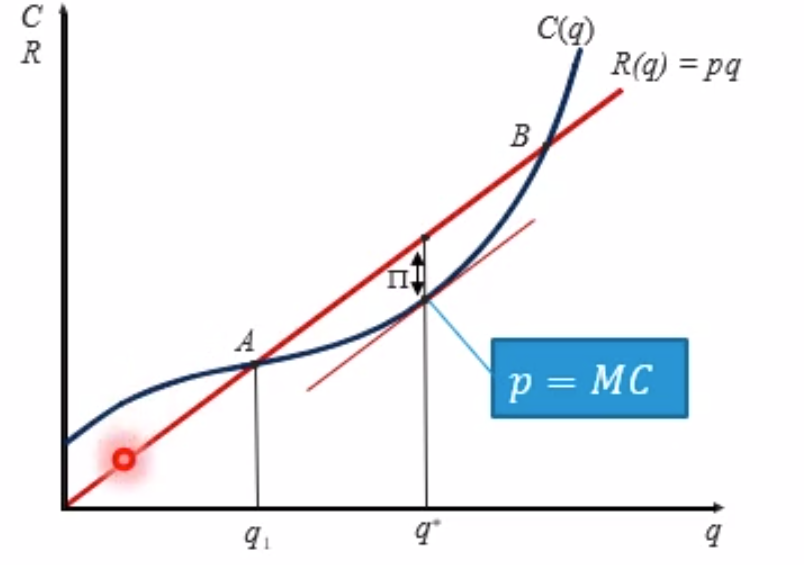
Graphical Solution
- finding largest difference (distance) between revenue function (linear, red) and costs (black, curved)
Demand Curve
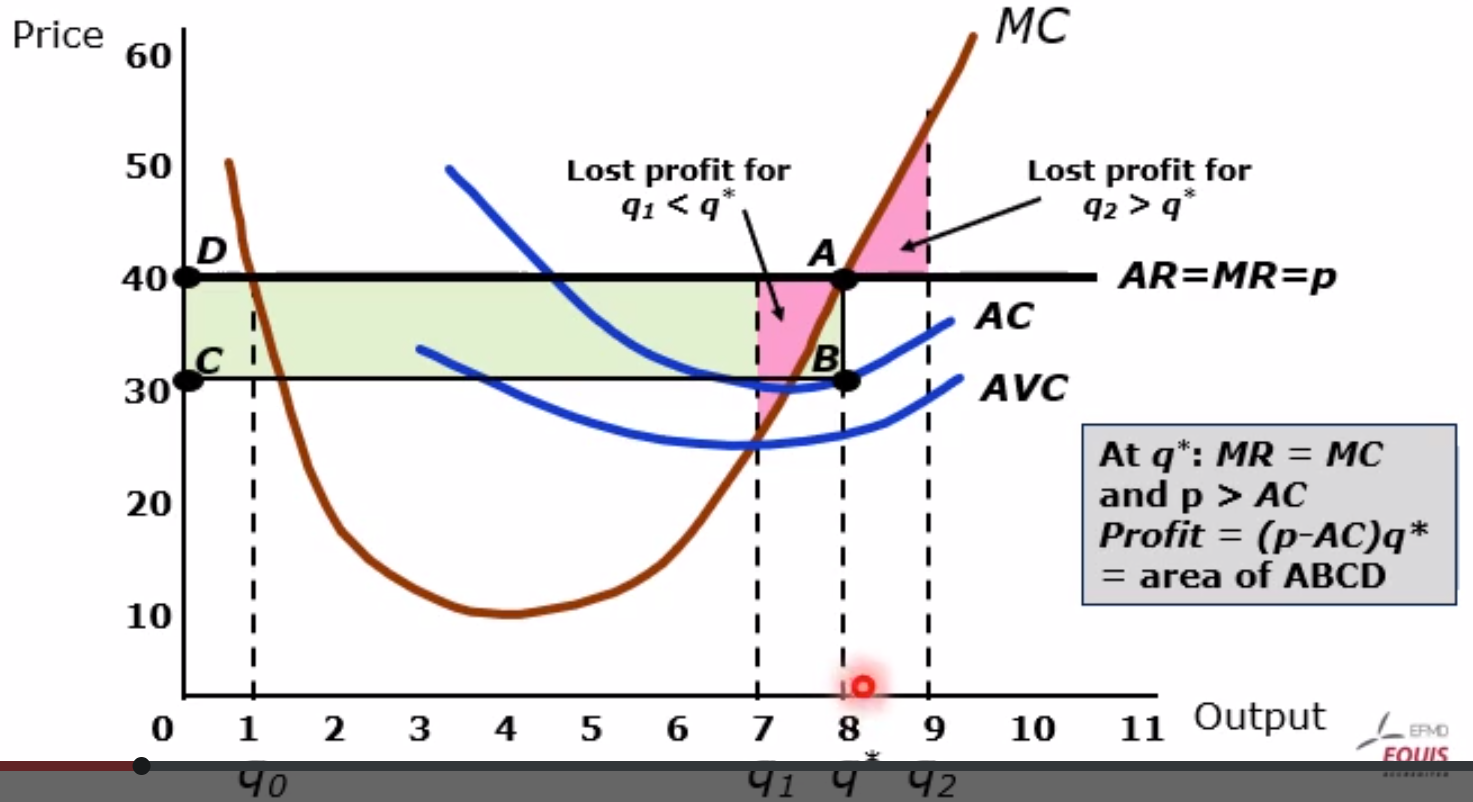
Graphical Solution
- red area → loss of producing more or less than optimal quantity
- have to ensure that producing at the best conditions is better than shutting down
- saving on fixed costs outweighs the opportunity cost
- if fixed costs cannot be saved, then operating normally is more beneficial
Shut Down Rules
- if fixed costs are sunk → Past Sunk Cost
- cannot shut down easily, producing is still better than stopping
- if fixed costs can be recovered / saved → closing is feasibile
Graphical Solution
- own Average Variable Cost must be below industry minimum Average Variable Cost
- Otherwise there could never be a profit
Industry Supply
- aggregation of all suppliers
- summing up
Equilibrium
- Equilibrium
- market clearing price reached → optimal price
- no excess supply → optimal supply
Long Range Equilibrium
-
equilibrium has been reached
-
now increase in demand (e.g. change in taste)
-
positive profits lead to new players enter the market
-
new players means increased supply and lower prices
-
lower prices result in zero profits
-
equilibrium reached again
-
can be run equally for decrease in demand
-
profit in the long run is 0
-
only supply and demand change, price will not
Competitive Equilibrium
- if costs are … then the long-term supply function is …
- constant → horizontal
- increasing → increasing
- decreasing → decreasing (Economy of Scale)
Short vs Long Term Equilibrium
-
short term
- Average Variable Cost is lower limit of price, otherwise shutting down
-
long term
- (profitability attracts more firms)
- supply increases, prices fall, until
- equilibrium reached → zero profits in long term
Zero Profit Condition
- does not mean that there is no money to be made
- competitive firms are compensated for opportunity costs
- there is no superior investment alternative for them
- no use selling the business and going after a more lucrative business
- Opportunity Cost is important
- implicit costs, fictitious employers salary, lost rent revenue
Welfare Characteristics
- 2 parties: Suppliers (Firms) and Consumers
- Consumer Surplus vs Supplier Surplus
- what each party gets from the interaction
- Supplier Surplus = Profit
- Pareto Efficiency → maximization of welfare
- welfare … supplier and consumer surplus
- no definition about distribution of surplus
- one being better off is at the cost of the other
- any Market Failure leads to efficiency loss
Maximum Price
- price ceiling can only be effective if below equilibrium price
- otherwise still equilibrium price → no effect of policy
- supply is restricted, demand increases
- producers are hurt, since less producer surplus
- Deadweight Loss
- Total Surplus is less than before
- consumer surplus is greater than supplier surplus
- if consumer surplus is greater than without policy (at cost of producer surplus) then consumers are effectively better off, otherwise just worse for everyone
- again: possibility of hurting both suppliers and consumers
- especially with highly inelastic products
- drugs (additive as well as medical)
- housing
- basic food items (potatoes, bread, rice)
Minimum Price
- e.g. minimum wage, essential tax on alcohol, tobacco
- price floor can only be effective if higher than equilibrium price
- otherwise still equilibrium price → no effect of policy
- demand decreases, supply increases
- suppliers (workers) are hurt, since less suppliers surplus
- overall welfare decreases
Price Support
- government as another consumer → increases demand
- consumer surplus decreases
- producer surplus increases
- overall welfare has increased
- still a Deadweight Loss since Government pays for more than is gained globally
Production Quota
- maximum quantity to be produced
- companies would like to produce more, but cannot
- consumer surplus decreases
- producer surplus increases
- overall welfare has decreased
- governmental payments for voluntary production restriction
- larger than overall surplus loss
- Deadweight Loss again
Import Quota
- maximum quantity to be imported into country
- trade restriction
- results in lower price → market will adjust to price change
- consumers surplus increase
- producer surplus decreases
Import Tariff
- bridge between domestic and world market price
- limiting imports → less imports than without tariffs
- producers will supply more, consumers will demand less
- government will receive tariff amount
- Deadweight Loss (potentially) again
Examples
- Lump-Sum Taxes
- e.g. taxes on profits
- Taxes on Consumption: Consumption taxes
- e.g. VAT
- analogous to decreasing the price, similar to Maximum Price
- 2 prices, 1 which consumers are paying, 1 which producers are producing with
- government receives quantity * tax
- overall loss of welfare → Deadweight Loss
4 Conditions
- Quantity sold and buyers price, must be on the demand curve
- Quantity sold and sellers price, must be on the supply curve
Incidence of a Specific Tax
- demand is inelastic → tax burden on consumers
- supply is inelastic → tax burden on suppliers
- Tax burden on consumers in % =
- Tax burden on consumers in % =
Subsidy
- government pays some part of the price
- increases demand
- Deadweight Loss again