Definition
Framework about strategic, interactive situations
Info
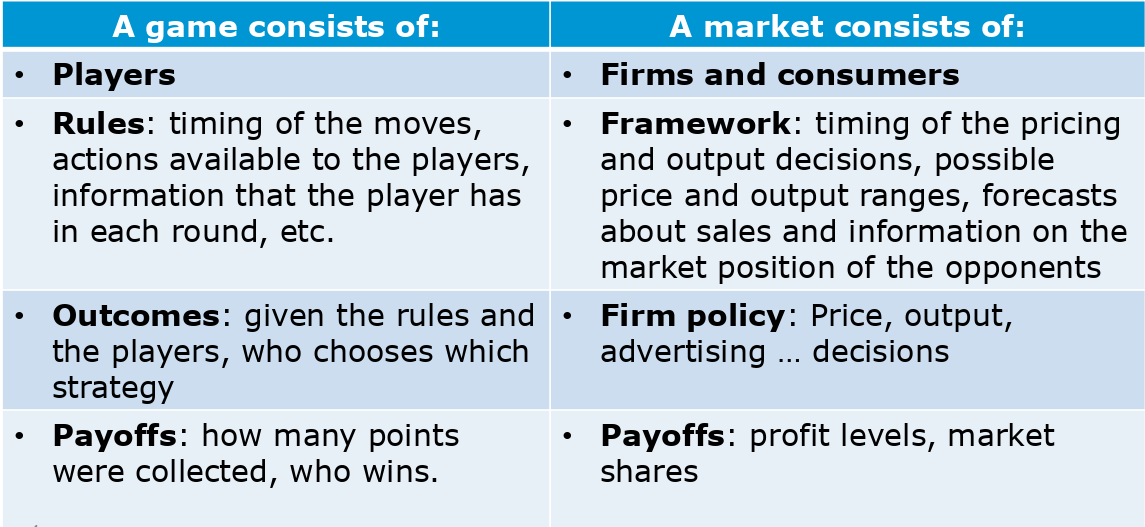
Game … interaction between multiple agents which effect the others Player … actor, agent in this interaction
History
- John von Neumann 1928
- John Nash 1949
- theory of Neumann and Morgenstern
- Nash Equilibrium
- Selten: subgame perfection 1965
- Harsanyi: incomplete information 1967
- Maynard Smith: evolutionary games 1972/82
Nobel Prizes
- 1944 von Neumann, Oskar Morgenstern
- 1951: John Nash for Nash Equilibrium
- 1965: Selten for subgame perfection
- 1967: Harsanyi for Incomplete Information Games
- 1972/82: Maynard Smith for Evolutionary Games
- 1994: John Nash, Harsanyi, Selten
- 2005: Aumann, Schelling
- 2007: Hurwicz, Maskin, Myerson
- 2012: Roth, Shapley
- 2014: Jean Tirole
- 2017: Richard Thaler
Games and Competition
- sequential or constant game
- game plan
- each player has a predefined action/reaction trees
- imagine chess with pre-planned moves (e.g. chess openings)
- no game plan for chess (too many options)
Assumptions
- every actor understands the payoffs of the game
- players have preferences
- Rationality - all players are rational → maximize payoffs
- complete knowledge
- all information is available to everyone
- everyone knows that all information is known by everyone
- players have unlimited reasoning and calculation ability
Criticism
- players are not rational
- not all players have all knowledge
Nash Equilibrium
- Nash Equilibrium
- for all players the utility has been maximized given the actions of the other players
- i.e. sticking to the current (best) option, since every other option is inferior for every player
- there can be more than one nash equilibrium, but there must always be at least one
- mathematical notation
Payoff Matrix
Types of Games
- static/simultaneous vs dynamic/sequential
- pure-strategy equilibrium vs mixed-strategy equilibrium
- complete information vs incomplete information
- information asymmetry → Economics of Information
- we will only cover complete information in Micro
- incomplete games in DS Decision Sciences
Solutions of a Static Game
- find the possible strategies of all players
- determine the payoffs
- find optimal strategies of all players
- reach Nash Equilibrium
Strategies
Multiple Equilibria - Battle of the Sexes
- when 2 strategies are exactly opposite to one another
- combination of all payoffs are equally beneficial
- multiple predictions are valid
- actual solution is outside of scope of analysis
- i.e. depending on actions of actors the system will reach any Nash Equilibrium
- 2nd order decision
- if there are multiple equilibria i.e. equally well for me
- then I can choose the equilibrium which hurts other player(s) the most
- Football vs Opera Game
Prisoners Dilemma
Maximin Strategy
- no complete rationality or not fully informed players
- even tho a Nash Equilibrium may be possible there is still the risk that the other player does not follow the optimal strategy
- when e.g. an investment is risky then it might be better to leave the dominant strategy and choose the risk-averse strategy
- risk-averse strategy → maximin strategy
- asking: “what is the worst thing that can happen?” for all possibilities
- maximin strategy → choose the best worst thing
No Solution - Mixed Strategy
Solutions of a Dynamic Game
Repeated Games
- giving a new spin to Dilemma Games
Finite Games
- game is played a number of times
- last-move optimization → state at last move will be nash equilibrium
- deviations from equilibrium are only possible, if the deviation is not punished in the next turn/state of the game
- First Mover Advantage can be meaningful
Info
- extensive form → decision tree
- think about pre-move decisions in chess
- Backward Induction
Infinite Games
- a game is not just played once, but infinitely many times
- i.e. there is no last move → no last-move optimization
- genuine repetition dynamics can flourish
- e.g. cooperation
- Discounting for future earnings
- First Mover Advantage only limited
Tit-for-Tat Strategy
- I do what you did to me last time
- this can sustain collusion for long times, even when there are disruptions
- Stackelberg Model
Grim Trigger Strategy
- I will collude, until you cheat only once
- after the first cheat, I will always compete with you
- this can sustain collusion for long times, until there is any disruption
Goals of Firms
Which actions give me an edge in the market?
- make entry unattractive → Market Entry Barriers
- best case: Monopoly
- hurting competitors
- reduce output
- stop producing entirely (exit market)
- setting threats
- empty threats
- threats against player with dominant strategy are futile
- they will always be on top of others, you can only reduce the overall social optimum
- empty threats
- First Mover Advantage - if present