Definition
Motivation can be defined as the force that initiates, guides and maintains goal-oriented behaviors.
A person’s motivation to pursue a certain goal is determined by situational stimuli, personal preferences, and the interaction of the two. → everything is an interaction
The forces that trigger motivation can be biological, emotional, cognitive or social.
Motivational Factors
Personal
- needs
- basic physiological needs, such as hunger and thirst, that are shared by all humans
- implicit motives
- affectively charged preferences for certain kinds of incentives (habitual propensities) that are acquired in early childhood (McClelland, Koestner, & Weinberger, 1989)
- explicit motives
- verbally represented (or representable) self-images, values, and goals that people attribute to themselves
Situational
- every positive or negative outcome that a situation can promise or signal to an individual is called an “incentive” and has “demand characteristics” for an appropriate action. Incentives may be associated with the action itself, its outcome, or various consequences of an action outcome
Candle
Intrinsic vs Extrinsic
Intrinsic
- within the individual
- autonomy
- mastery
- purpose
Example
- hobbies
- mastery of a skill
- purpose in pursuing a hobby
Extrinsic
- outside the individual
- compensation
- punishment (or fear of)
- reward
Example
- work
- university
Combination
-
n = 51 kids, 40 to 63 months old
-
measure of intrinsic motivation: how long the children were drawing
-
3 conditions
- expected reward: told before they receive a reward
- unexpected reward: not told before but still receive a reward
- nothing
-
intrinsic motivation (unexpected reward and no reward) > external motivation (told to receive a reward)
Crowding-Out Effect
-
When external interventions (e.g., external rewards) undermine intrinsic motivation for an activity that is originally intrinsically motivated
-
According to the Cognitive Evaluation Theory (Deci & Ryan, 1985), the following conditions have to be fulfilled:
- the activity is originally intrinsically motivated &
- the external intervention diminishes a person’s sense of autonomy and / or sense of competence
-
External interventions which are perceived as controlling undermine a person’s sense of autonomy, e.g.:
- Expected tangible rewards which are directly contingent on behavior
- Performance expectations that convey pressure
- Strict deadlines
-
External interventions which are not perceived as controlling or to a lesser extent, e.g.:
- Tangible rewards which are not directly contingent on behavior
- Unexpected tangible rewards
- Setting your own deadlines
-
External interventions undermining a person’s sense of competence, e.g.:
- Negative feedback without any “informational” value
- Negative performance expectation without any “informational” value
-
External interventions strengthening a person’s sense of competence, e.g.:
- Positive feedback
- Positive performance expectations
- “informational” feedback
- Workshops / training tailored to a person’s needs, helping to improve their skills / advancing their knowledge
Pay-for-Performance
- e.g. commissions
- could earn infinite if one could work infinite
- can incentivize the wrong thing
- e.g. reducing quality of sales for higher current sales count while sacrificing future sales count
Algorithmic vs Heuristic
Algorithmic Tasks
- e.g. assembly line work
- mostly extrinsic motivation
- monetary bonus or promotion
- goal is high quantity
Heuristic Tasks
- e.g. coming up with ad campaign
- mostly intrinsic motivation
- goal is high quality
Promoting Intrinsic Motivation
- foster autonomy
- acknowledge competence
- opportunities to improve skills
- create purpose and meaningful rationale
Purpose-Driven Jobs
History
- history is not exam relevant #wontfix p1 5 25
Away from Behaviorism
- cognitive movement
Needs
Competition
- Humans are achievement-seeking creatures: our effort can rise or fall as we benchmark ourselves against others
Rivalries
- individuals are particularly motivated to defeat an opponent with whom they have a history
- Rivalries are double-edged swords that can motivate high levels of effort but also counterproductive behaviors.
- raises the perceived stakes of a competition even though the actual stakes are the same, motivating people to work harder, smarter, and longer
- increases the motivation to achieve a gain & compel individuals to focus on goal attainment
- increases arousal and physiological response (e.g., faster heartbeat)
- increases the likelihood of taking risks
- sometimes motivates the violation of rules and unethical behavior (focus on the benefits of winning rather than on the costs of acting immorally )Rivalries are double-edged swords that can motivate high levels of effort but also counterproductive behaviors.
Forming Constructive Competition
It is crucial to understand how to obtain the benefits without the costs
- fairness promotes constructive competition (e.g., Tjosvold et al., 2003, 2006)
- chances of winning should be equal for all employees if they put in the appropriate amount of effort (Johnson & Johnson, 2009)
- clear rules and a clear time frame (Johnson & Johnson, 2009)
- winning alone should not be of utmost importance (Johnson & Johnson, 2009)
- Employees must have a vested interest in their rivals’ success as well as their own (Sheridan & Williams, 2011)
- Incentives can temporarily encourage cooperation between competitors but, building a relationship can maintain cooperation (Sandvik et al., 2020)
- The temporal order matters: Shifting from collective to individual rewards can foster friendly competition the reverse most likely leads counterproductive behaviors (Johnson et al., 2006)
- The presence of a common outgroup promotes cooperation (Sonenshein et al., 2017)
Improving Knowledge Flows
- n = 653 sales agents
- design
- structured meetings: instructed to meet up and share knowledge
- pair-incentives: pairs had joint boni
- control treatment: no intervention
- results:
- structured meetings: 15% sales gain → huge gain
- both partners increased, not just the one that learnt a lot
- pair-incentives: small increase during experiment, but not after experiment
- control group: nothing much changed
- structured meetings: 15% sales gain → huge gain
Prophecies
Self-Fulfilling Prophecy
- when I think my girlfriend will break up with me I treat her badly until she does - I was right in the end
Self-Negating Prophecy
- classic underdog evolution ark in any movie
Motivation of the Underdog
- n = 596
- design:
- underdog: You are not cut out for the task
- favorite: You are perfect for the task
- result:
- underdog: depending on source of bad feedback
- if source is credible: “they are probably right, I can’t do that, I give up”
- if source is not credible: “they don’t know anything about me, I will prove it to them”
- favorite: little impact
- underdog: depending on source of bad feedback
Prosocial Motivation
- desire to help/benefit others
Benefits
- increased social capital
- build status, trust, goodwill
- working smarter
- boot productivity, more creative
- working harder
- provide purpose
- working safer
- encourage caution, discourage risk, consider consequences for others
Foster Prosocial Motivation
- make it personal
- personalizing and humanizing
- highlight task significance
- give the right incentives
- nonfinancial awards
- prosocial bonuses
Dark Side of Prosocial Motivation
- more likely to escalate their commitment → burnout
- poor time management → too much commitment at once → burnout
- rationalize otherwise indefensible actions and motivate unethical behavior
- e.g. stealing is not ok, unless you do it for charity
Passion
- 20% of workers in US are passionate about their work (n=3000)
- passion … Leidenschaft → being able to suffer for your work
- focus on what you care about - not what you love
- people passionate about their work are not good in the long run
- struggle taking breaks or days off → burnout
- quitting more frequent, sick leaves are more frequent and for longer
- stepping away from work sometimes is very important
- commit to 5 breaks today, when do you want to take them?
- they do matter → breaks and productivity correlate strongly
- (Jachimowicz, 2019)
- they do matter → breaks and productivity correlate strongly
- commit to 5 breaks today, when do you want to take them?
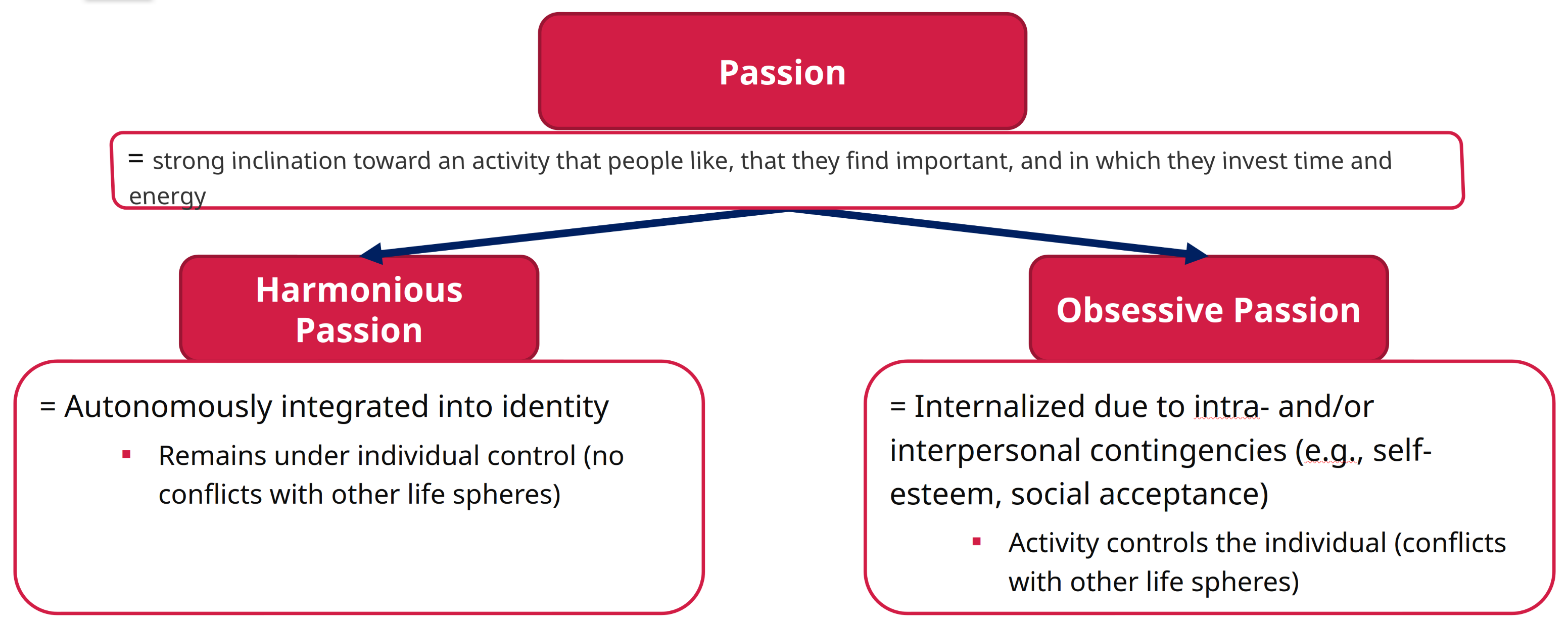
Dualistic model of Passion
- passion
- strong inclination toward an activity that people like, that they find important, and in which they invest time and energy
- harmonious passion
- Remains under individual control (no conflicts with other life spheres)
- obsessive passion
- Internalized due to intra- and/or interpersonal contingencies (e.g., self-esteem, social acceptance)
- Activity controls the individual (conflicts with other life spheres)
- work-life balance is not good
Passion & Achievement
- total n=38.481
- passion
- general passion
- dualistic model of passion
- role-based passion
Passion & Burnout
- Fernet et al (2014)
- n = 246 + 589
- setup
- answer to single survey or to 2 surveys with 12 months gap
- measures
- obsessive & harmonial passion
- burnout (emotional exhaustion, depersonalization, accomplishment)
- job autonomy (decision autonomy, control over job tasks)
- result
Effort
Effort = Meaningful
- Inzlicht & Campbell, 2022
- if it is not effortful to do it is mostly not worth doing it
- humans avoid mental and physical effort
- BUT even in Universal Basic Income studies and lottery winners decide to keep working
- Effort can help to escape boredom and thus give meaning
- Effort might help to release cognitive dissonance
- The effort and meaning connection might be illusory and a way for organisms to make sense of past actions
- Or: effort’s meaningfulness is not illusory, but in fact a statistical property of the real world
- Effort’s perceived meaningfulness, then, might act as a system-justifying force
- Effort as a proxy for moral characteristics
Collaboration
Motivating yourself and others in group work
- university: 1 shot project, work: repeated people
- random group assigning is demotivating
- if in random group: start with icebreaker questions, then talk about getting stuff done
- random group assigning is demotivating
- you should pick 1 leader to organize meetings, take care of deadlines, etc
- if there is something nobody likes doing, randomize the assignment
- give some incentive (e.g. not doing as much with content part)
- if there is something nobody likes doing, randomize the assignment
- if you can’t be bothered to do much, just do something
- if someone else is not motivated, don’t require a lot from them, otherwise they will refrain completely
- if someone is procrastinating, set them earlier/tighter deadlines, work with peer pressure
- how to handle spite? with a leader
- even if the leader is not actually superior (we are all students after all) they are “superior” because of their leader-role they are assigned
- better, if the leader is assigned (just another role), rather than the leader just stepping forward (dictator)
- even if the leader is not actually superior (we are all students after all) they are “superior” because of their leader-role they are assigned
Motivation in Collaboration
- dynamics of others are important
- if you are not motivated keep it to yourself
- otherwise you are bringing the rest of the group down
Remote Motivation
- General effects of remote work:
- Positive effects: flexibility, reduction in commuting time, increases in productivity, employee retention, job satisfaction etc. (Martin & MacDonnell, 2012, Tavares, 2017).
- Negative effects: reduced job satisfaction and productivity, social isolation, higher stress, presenteeism, communication blocks (Bailey & Kurland, 2002, DiMartino & Wirth, 1990, Kim et al., 2021, Steidelmüller et al., 2020).
- Remote Work and Motivation
- On the one hand: associated with lower levels of motivation, e.g., through professional isolation (Hitka et al., 2021, Imdad & Duffy, 2021, Romeo et al., 2022)
- On the other hand: home office as predictor of greater job motivation (Hill et al., 2003)
- How does this go together?
- Having the flexibility and the autonomy to decide when to work remotely or when not to remotely is important (Hill et al., 2003)
- Full-remote vs. only 2-3 days (Cailier et al., 2011, Shimura et al., 2021)
Work From Home
- n = 1612
- Procedure:
- Randomized control trial
- Trip.com decided to evaluate hybrid WFH
- Employees with odd birthdays were randomized into the treatment group allowing hybrid-WFH
- Results:
- WFH reduced attrition rates by 35% and improved self-reported work satisfaction scores.
- WFH reduced hours worked on home days but increased it on other work-days and the weekend.
- WFH employees increased individual messaging and group video call communication, even when in the office.
- No impact on WFH performance reviews or promotions (BUT small, potentially positive impact on productivity).
Remote Work, Basic Needs
- n = 199
- Measures:
- Work-related need satisfaction (competence, relatedness, autonomy) before/after working from home
- Personal and Organizational resources (e.g., role clarity, job control, social support)
- Daily assessment of work motivation and well-being
- Results:
- Lower relatedness when working from home
- Positive influences of job control on autonomy/competence and of social support on relatedness
- Well-being and motivation were at acceptable levels and improved over the course of the study
- Feelings of competency were positively related to work engagement, flow and positive affect
Implement Remote Work Correctly
wontfix not exam relevant