General
- goal is redirecting capital flows
- targeting banks and other investors when giving out loans
- 2 parts
- does not need to be transposed → regulation
- in effect since 2021
- EU classifies what is green and what isn’t
- addresses Green Washing → less approved
- DWS Case
- activists challenge green washing
- rather report honest 0% alignment than fake 10%
- any kind of defense industry is not deemed as green
- defense industry will hopefully face higher financing costs therefore
- addresses Green Washing → less approved
- have to separately report on
- Revenue
- CAPEX
- OPEX
- generates a percentage on how much money is used or made for/from green endeavors
- problems:
- perspectives change rapidly (e.g. is nuclear energy green or not?)
- laws are slow to change (technological advancements may be too fast)
- problems:
- collecting data on all subsidiaries around the world
- digital infrastructure
- data collection (finding out about data points)
- Digital Tagging
- digital infrastructure
Incentives
- since incentives are only in full (e.g. all of a plant is powered by hydrogen) the incentive if 100% coverage is not possible to just not indulge in it anyways
- a razor blade separating into feasible and non-feasible options, no mix between them possible
Qualitative Reporting Requirements
- accounting method
- how was aligned Revenue/CAPEX/OPEX determined
- double counting
- methodology to avoid double counting
- economic activities
- explanation of relevant activities and weights
- additional information
- relevant background information
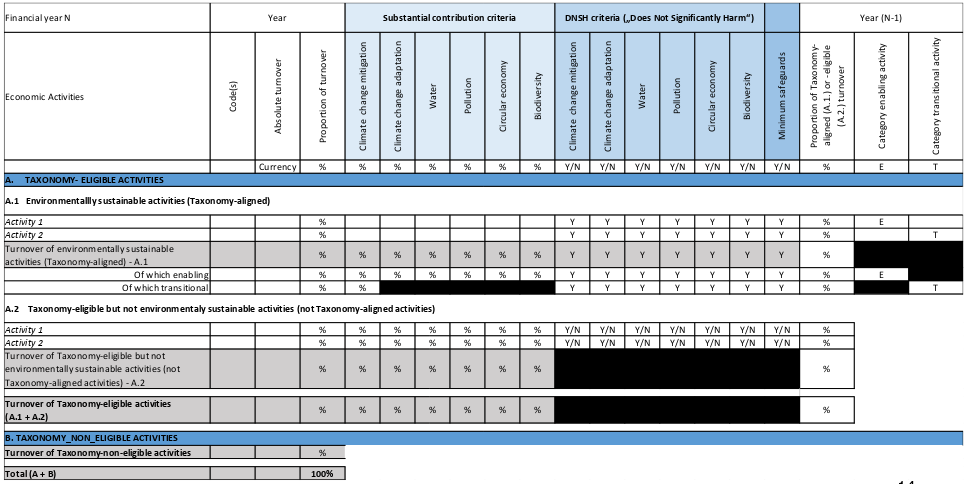
Taxonomy Table
- for each of Revenue, CAPEX, OPEX a separate table
- percentage of aligned/not aligned activities
Legal Stuff
- EU 2020/852
-
- delegated act 2021/2139 (objectives 1-2)
-
- delegated act 2023/2485 (objectives 1-2)
-
- delegated act 2023/2486 (objectives 3-6)
-
- delegated act 2022/1214 (include nuclear and gas energy)
- transitional only
- delegated act 2022/1214 (include nuclear and gas energy)
-
- official tools
- EU Taxonomy Regulation Compass (very helpful)
- EU Taxonomy Calculator
- EU Taxonomy FAQs C/2023/305
Parents/Subsidiaries
- each subsidiary large enough has to report on their own, even if included in parents consolidated report
- subsidiaries not large enough to report on their own can be just included in parent company
Environmental Objectives (art 9)
- climate change mitigation
- climate change adoption → similar to E1 mandatory before 2024
mandatory after 2024 3. sustainable use and protection of water and marine resources → similar to E3 4. transition to a circular economy → similar to E5 5. pollution prevention and control → similar to E2 6. protection and restoration of biodiversity → similar to E4
What to do?
-
Taxonomy Eligibility: screening of economic activities
- if it is listed, it can be aligned
-
substantial contribution
- to one of the objectives
-
do no significant harm
- to other the objectives than the contributed to one
-
minimum safeguards
-
= taxonomy alignment in % for each economic activities
-
then sum up alignments of activities by weight of economic expenditure
-
= total taxonomy alignment in %
- for CAPEX/OPEX/Revenue separately (influences weights)
Shortcomings
- political
- some unsustainable practices deemed as sustainable and vice versa e.g. Germany and gas power generation
- quite technical
- only focus on environment
- very little social or governance aspects
- there are plans to integrate a social aspect as well
- would include: decent work, adequate living standards, inclusive & sustainable societies
- finalization not before 2025, probably later
- there are plans to integrate a social aspect as well
- very little social or governance aspects
- minimal safeguards
- does not prohibit unsustainable activities, only disclosure requirement
- Transparency Theory still applies
- exhaustive list
- economic activities can be missing → All Activities in an Economy - Sustainable View
- e.g. company is reporting 50% not-aligned, 20% aligned, 30% not-eligible
- 30% not eligible can be sustainable, but are not even included, because exhaustive list
Empirical Evidence
wontfix L5 15-18