paper source: https://canvas.wu.ac.at/courses/3581/files/236443?module_item_id=56592
📎 Executive Summary
There is more to income than money on your bank account. Social Income is also a vital part in sustaining communities and providing for societies. The basics: all humans need similar things. These things need to be provided, otherwise a modern lifestyle cannot be fulfilled.
👁️ Key Findings
- 5 types of universal needs
- “social income” based on meeting of those needs for less money or free (because state sponsored)
- low-income households profit most
- entitlement per-person can be difficult → legislatively difficult
- reduce income inequality by 20%
- Transactional Service Model vs Providing Service Model
- should refugees be included? who is part of the welfare system?
- based on residency and not necessarily on passport?
- Through Covid the “Essential Jobs” have been identified
- aims for UBS
- equity
- efficiency
- solidarity
- sustainability
✅ Similarities
similarities to other papers or what other people think/write, link them here
⚔️ Differences
differences to other papers or what other people think/write, link them here
📖 Content
Kinds of Universal Needs with their suppliers/satisfiers
| Universal needs | Contemporary need satisfiers | Provisioning systems: the foundational economy |
|---|---|---|
| Nutrition | Nutrition Adequate nutritious diets; food security | Agriculture, food processing and food retailing systems: ‘from field to fork’ |
| Shelter | Adequate, secure, affordable housing | Housing: land, building, owning, letting |
| Energy | Utilities | |
| Water and Sanitation | Utilities | |
| Social Participation | Education | Schooling and adult education |
| Information | Phone, computer and internet con- | |
| communication | Access to effective and healthy means | |
| Health: prevention, cure, | Public health | Public health services |
| Physical security | Emergency services | Emergency services |
| Income security | Employment | Decent, secure jobs |
| Income Maintanence | Social security; private insurance | |
| Money/payment systems | Retail Banking |
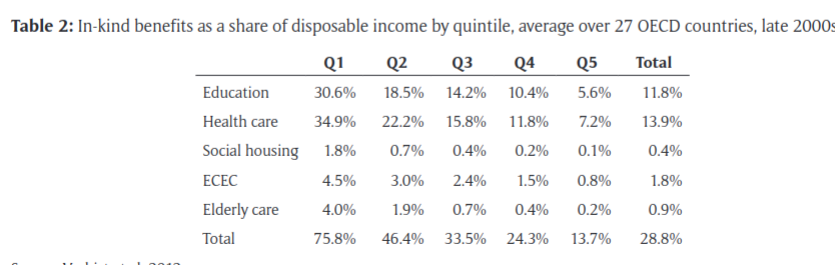
In-Kind benefits as a share of disposable income by quintile
Essential Jobs
- health and care or emergency services
- farmers, supermarket staff,
- workers in water, electricity, gas and oil, teachers
- telecommunication workers, transport staff,
- workers in law and justice, religious staff, social security staff and retail banking staff