Experiments
Bounded Rationality / K-Level Reasoning
Limited depth of Reasoning
- how far can you think?
- k-level thinking models
- different levels of rationality, expressed by
- level-0 players play the simplest strategy (not dependent on other players behavior)
- e.g. random, just cooperate, just copy other person
- comparable to the strength of a chess engine
- how many moves will the computer think ahead?
- chess engine measured in “depth”
- methodology
- you as a k-level thinker think about how (k-1..0)-level thinkers think and predict their decisions and play the best response based on that estimate
- everyone believes they are the smartest person in the room
- (k+1) and (k) are not taken into consideration, otherwise the own k-level would be higher again
- practical application/experiment
- issues
- all depends on level-0 players choice
- random? intuitive choices?
- frequency can be econometrically estimated, but should be constant across games
- it’s not an equilibrium concept
- race to the top with k-level … higher is better
- think of chess engines → higher depth = stronger
- can be an equilibrium if is infinite
- all depends on level-0 players choice
Punishing Strategies
- “I start higher and undercut when I am being undercut”
- incentive of last round: undercut
- again via Backward Induction: SPNE is always to undercut
Tit-for-Tat Strategies
- if you undercut me once, I will undercut the next time
- if you come back up again I will too
- punish once, then up for cooperation again
- outcome: I play the safe option in the first round, then whatever the other player played in the last round
Info
If the future is important enough (i.e., sufficiently large), then given that all players play a trigger strategy, deviation is not profitable. Thus, those trigger strategies are an equilibrium.
One-Time Deflection
- deflect once - then other player deflects once, then collude all time
- important part is that the sum is multiplied with 6 … colluding payoff
All-Time Deflection
- deflect once - then other player deflects too, deflect all time
- important part is that the sum is multiplied with 2 … non-colluding payoff
Folk Theorem
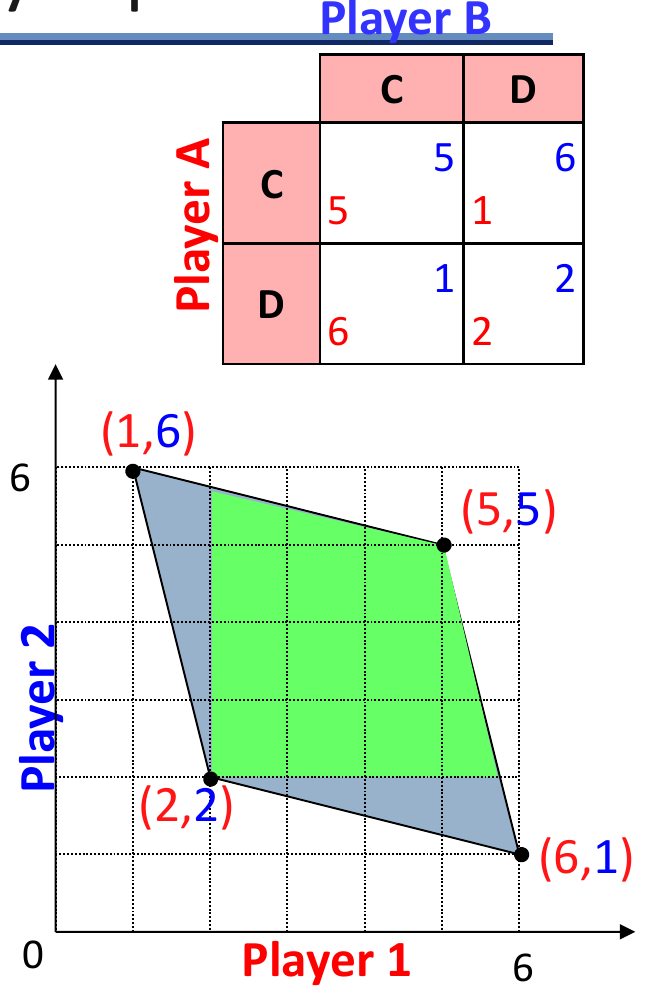
- G … n-person static game, complete information
- e … payoff vector
- x … feasible vector in G
- if any player wants to deviate from then the players can just return to the NE by either Tit4Tat or Grim Trigger strategies
- threat of going back to NE is always credible
- any strategy in the green region is feasible, therefore can be sustained
- why “Folk Theorem” - everybody knew about it but nobody published it / wrote it down in notation
Grim Trigger
- “I will start with cooperation, cheat me once and I will cheat you always”
- with fixed Discounting rate I can calculate the Diminishing Marginal Returns of every further route
- also called “under the shadow of the future”
- wontfix gt 5 41
- threat is credible, the one-shot Nash